


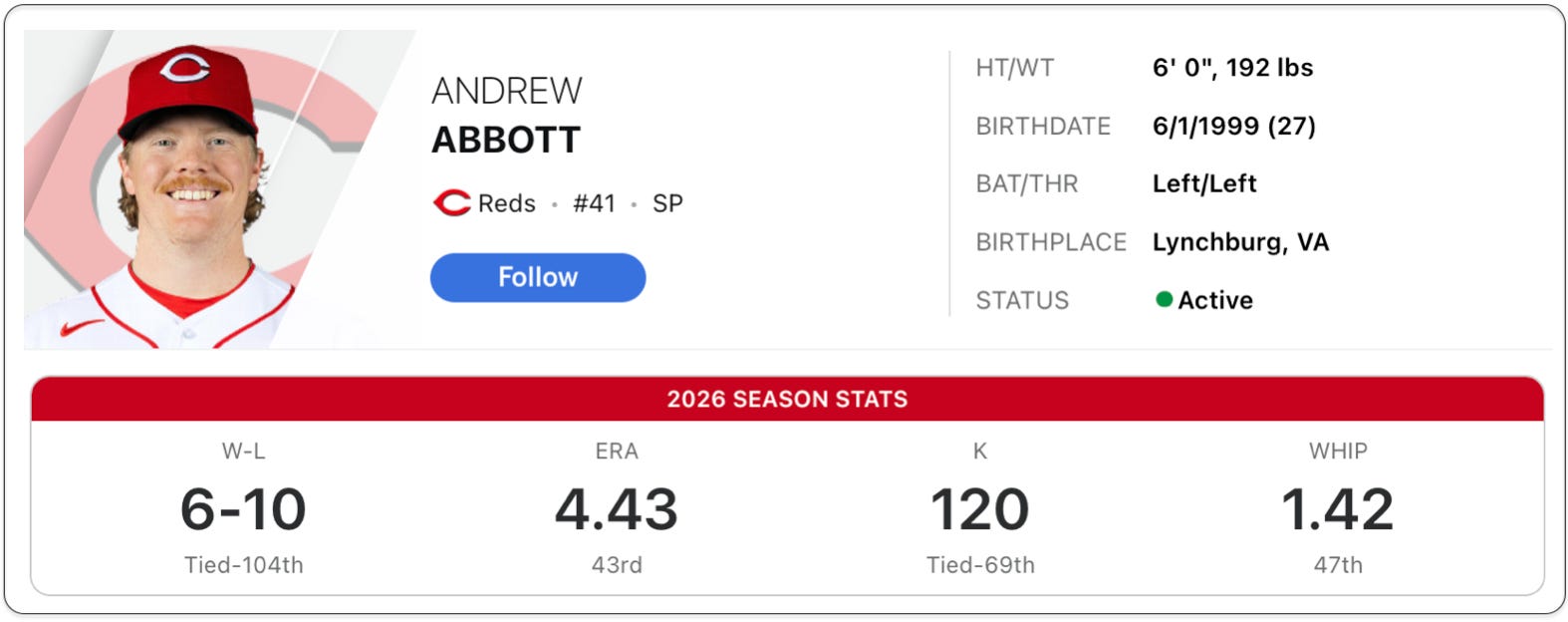
Uni Watch is usually about the visual world, but today I want to talk about something from the world of words and phrases. Consider Reds pitcher Andrew Abbott, whose stats are shown above (and who I chose completely at random for this discussion). For most of my life, a writer or broadcaster referring to his earned run average would use one of the following phrasings:
“He has a 4.43 ERA.”
“His ERA is 4.43.”
“… and a 4.43 ERA.”
But at some point in the past 10 to 15 years, we entered a new ERA era. It’s increasingly likely that a writer or broadcaster discussing Abbott’s statistics would now say that he has “pitched to a 4.43 ERA.” To be clear, the older wordings are also still in use, but the newer “pitched to a” wording has staked out some serious rhetorical real estate in recent years, and its use appears to be growing.
For reasons I can’t fully explain, the “pitched to a” phrasing makes me itchy. Maybe it’s that it feels unnecessarily wordy and thus inefficient; maybe it’s that it sounds too jargon-y; maybe it’s just that it’s not what I grew up with. In any case, it seems like a classic case of fixing something that ain’t broke. If the guy has a 4.43 ERA, just say he has a 4.43 ERA! But an increasing number of baseball media members apparently don’t see it that way.
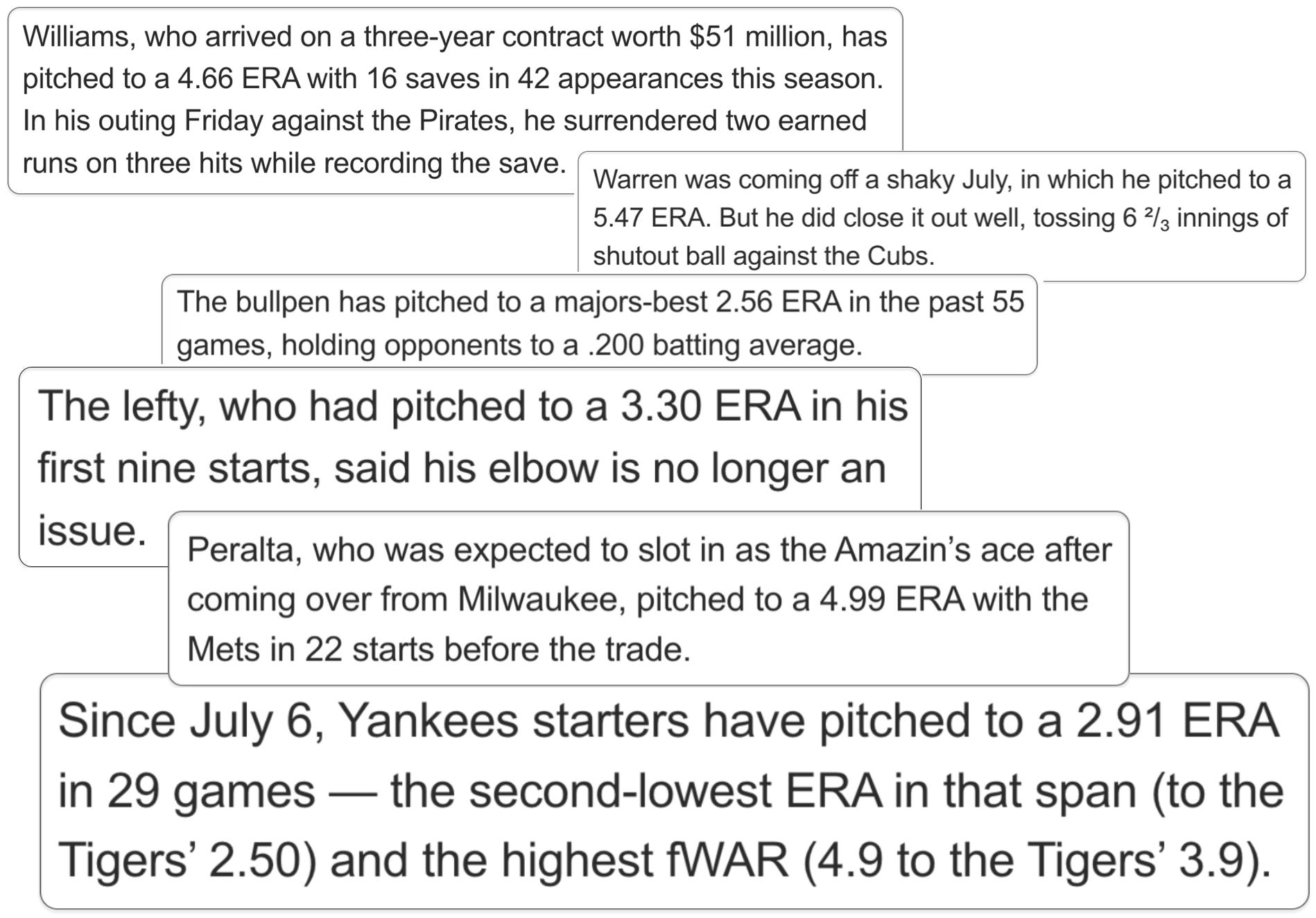
Why did this new expression come into vogue? Does it reflect some sort of newfangled approach to assessing statistics? Something analytics-driven, maybe? My initial research came up empty, so I contacted longtime baseball scribe Jay Jaffe, who currently writes for FanGraphs after previous stints at SI.com and Baseball Prospectus, to see if he had any insights.