


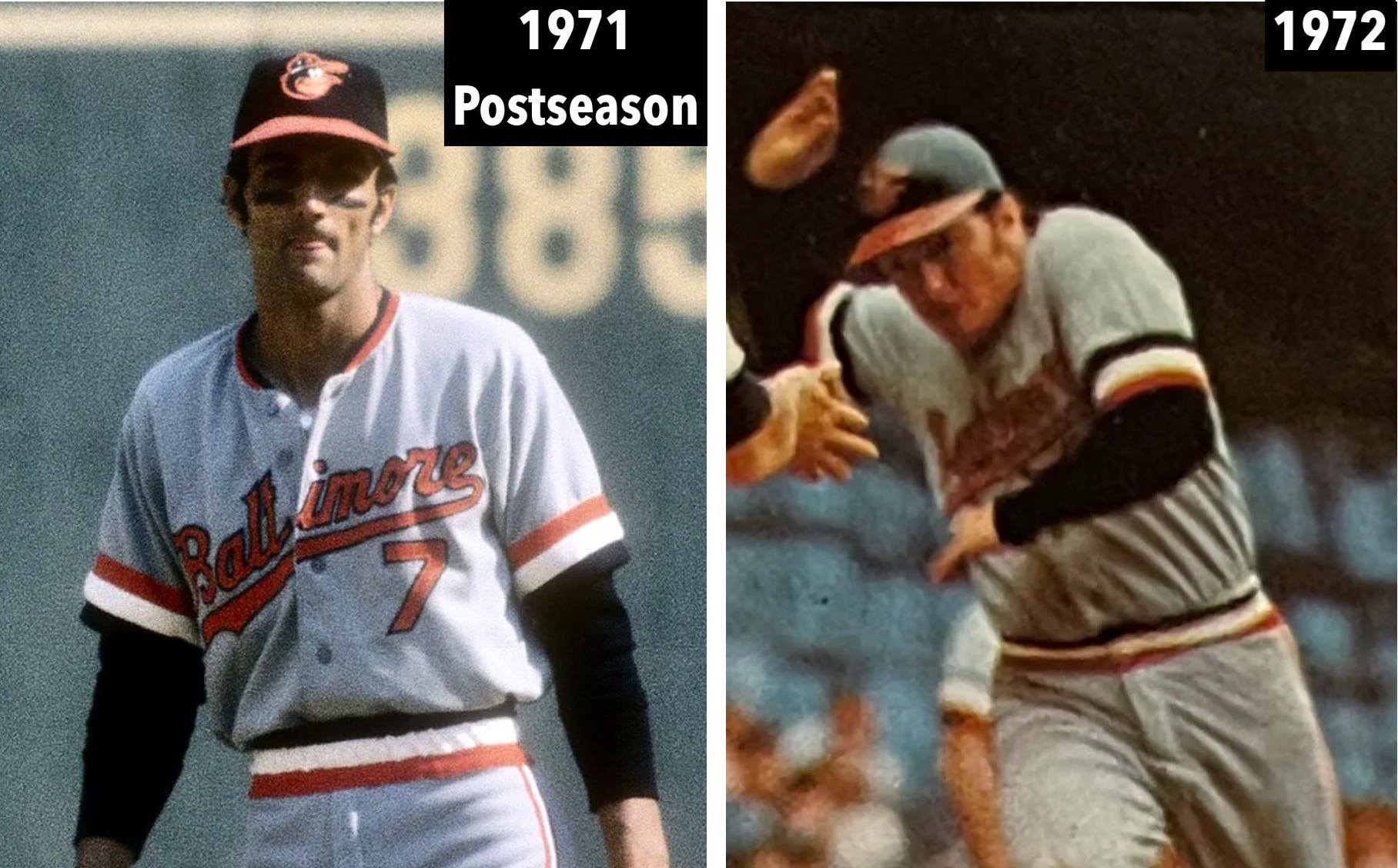
I recently wrote about the bewildering uniform situation surrounding the early-1970s Baltimore Orioles. Among other things, I noted that their 1972 road jerseys were almost the same as the ones they’d worn in the 1971 postseason, except that the color sequence on the sleeve cuffs had been reversed. As I wrote, “[The] ’72 jersey sleeve striping sequence makes more sense than the ’71 postseason version. If the black stripe is on the bottom, it just blends in with the black undershirt. Putting orange on the bottom provides some contrast.”
But there’s another factor I didn’t mention: The ’72 sleeve cuff striping matches the pants striping on the sansabelt waistband, which seems like, you know, how things ought to be. Once you notice the cuff/waistband mismatch in the ’71 photo, it feels like like the cosmos is slightly out of alignment, no?
And that got me thinking: During MLB’s sansabelt era — 1970 through 1992 — how often did this type of cuff/waistband mismatch happen? It seems like the kind of thing I would have written about years ago, but I’m pretty sure I’ve never looked into it.
As I pondered that question, I quickly realized that a few teams used solid-colored sansabelt waistbands during this era, so there were no striping issues for those clubs. And lots of other teams went with symmetrical two-color striping for both the pants and the sleeves. The real issue, then, is how teams with three-color striping — like the Orioles — handled things.


Creating a comprehensive account of this phenomenon is more complicated that you might think. Back in the sansabelt era, most teams used different manufacturers for their home and road uniforms, and many of them occasionally reused old jerseys or pants from previous seasons. Also, as we’ve seen before, Marc Okkonen’s “Dressed to the Nines” uniform database is not always accurate, so we can’t treat his mock-ups as gospel.
So instead of trying to piece together a definitive guide to three-color cuff and waistband striping, I’ve identified the teams that used three-color striping for at least part of the sansabelt era and shown some of the ways they handled things. This is not meant to be a complete or authoritative account; it’s more of a survey of some of the ways teams addressed the cuff/waistband issue.
I’m leaving out the Orioles, since we’ve already discussed them. Ready? Here we go:
American League
Cleveland
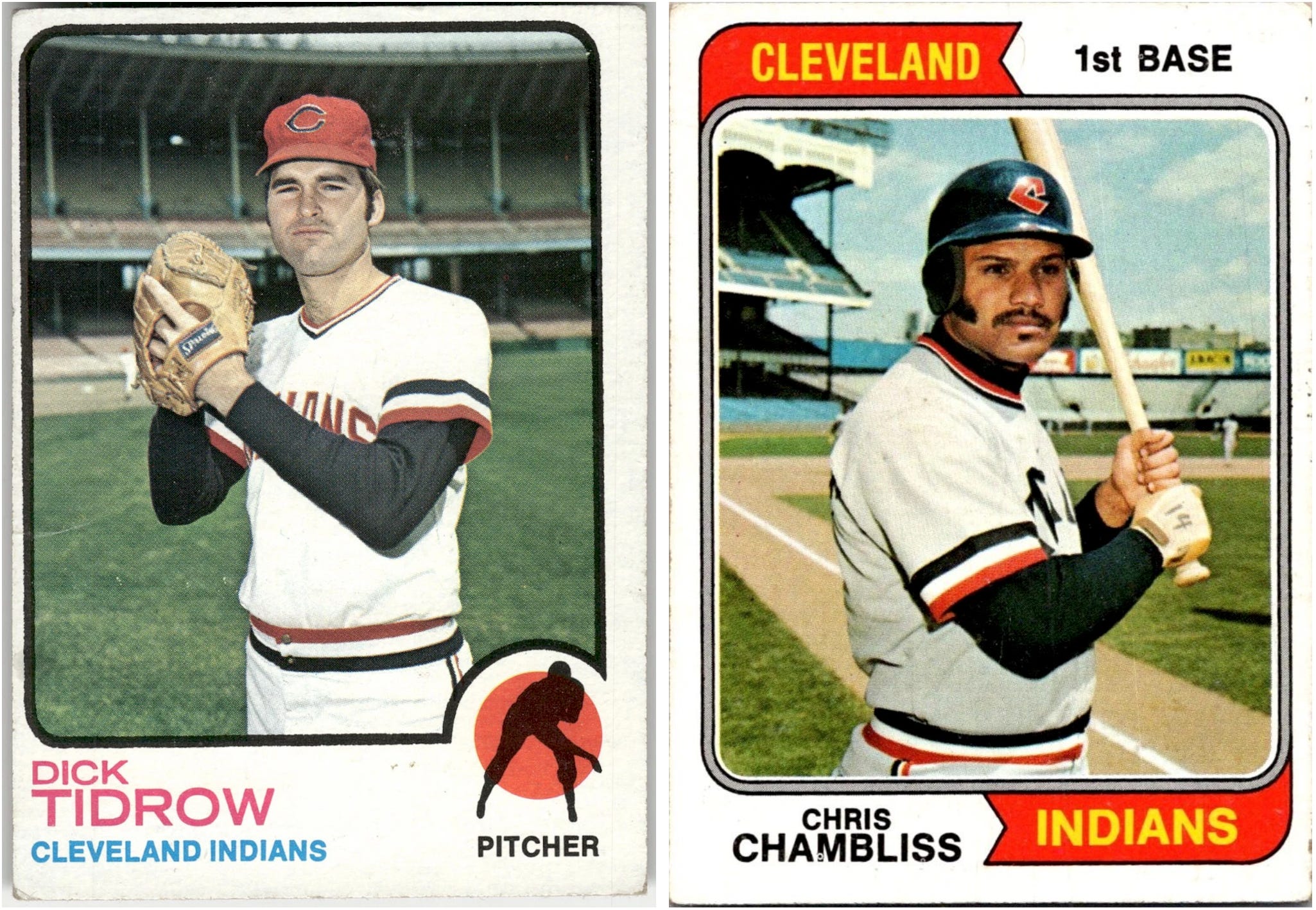
Cleveland’s uniforms were a bit of a jumble during this period — they had red alternates, navy alternates, the blood clot combo, and more — so perhaps it’s not surprising that they were inconsistent about whether their cuffs and waistbands matched. Sometimes they did, and sometimes they didn’t!